
The U.K. real estate market has long been regarded as a barometer for global property trends — a reflection of changing investor sentiment, economic shifts, and lifestyle preferences. Today, as the Dubai property market continues its meteoric rise, many investors and analysts are turning their attention to the U.K. housing sector to understand what signals it sends about Dubai’s ongoing real estate evolution.
In this article, we dive deep into how London’s mature property dynamics mirror and influence Dubai’s transformation — from luxury living standards to sustainable development and digitalization in real estate.
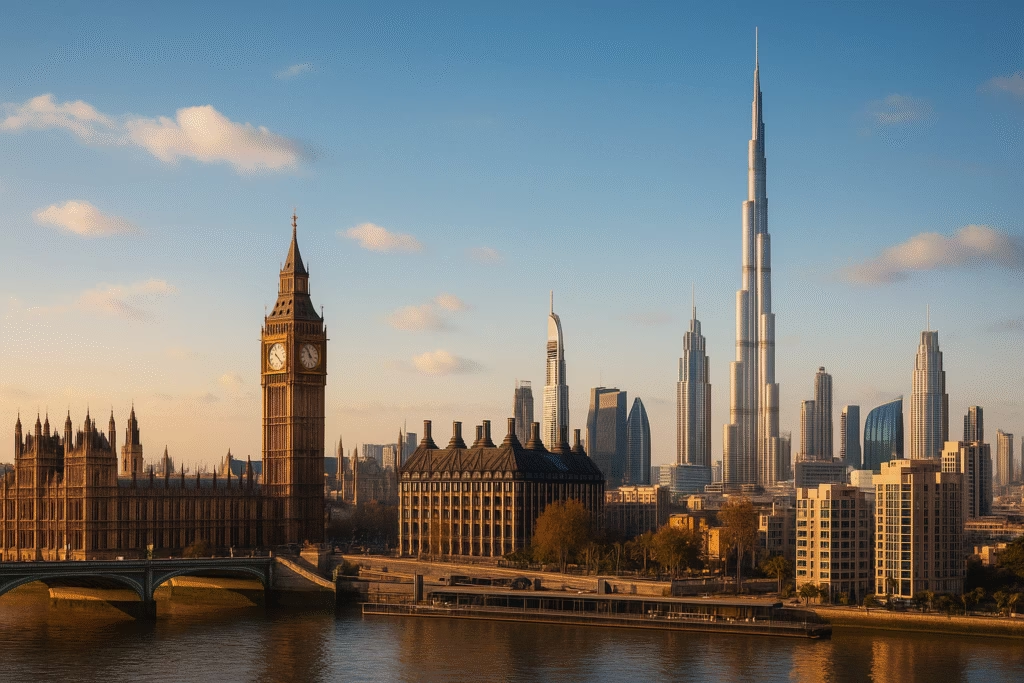
The U.K. Market: A Historical Beacon for Global Property Trends
The U.K. property sector, particularly in London, has traditionally set the tone for international investment behavior. London’s real estate market thrives on stability, transparency, and regulation — key elements that have shaped global investor confidence for decades.
However, with rising interest rates, geopolitical uncertainty, and shifting demographic demands, the U.K. market has entered a period of recalibration. Average property prices in prime areas like Kensington, Chelsea, and Westminster have plateaued, leading global investors to diversify — and increasingly, that diversification points toward Dubai.
How U.K. Market Shifts are Driving Global Capital Toward Dubai
1. Return on Investment (ROI) Comparison
One of the most telling signals from the U.K. market is the diminishing ROI on residential assets. The average rental yield in London currently hovers around 3% to 4%, while Dubai offers an impressive 6% to 8%, with certain areas such as Business Bay and Jumeirah Village Circle (JVC) even crossing the 9% mark.
This vast difference in yield has positioned Dubai as a high-return alternative for investors who once relied on the U.K. for consistent income streams.
2. Currency Advantage and Tax Benefits
The British pound’s volatility post-Brexit, coupled with Dubai’s tax-free property ownership policies, has further strengthened the emirate’s appeal. U.K. investors can now acquire luxury assets in Dubai at relatively lower entry points, especially as the dirham’s peg to the U.S. dollar offers stability unmatched by the pound.
The absence of capital gains and property taxes in Dubai amplifies this advantage, allowing U.K. investors to maximize net profits — a benefit rarely found in London or Manchester.
Dubai’s Evolution: Learning from the U.K. Model
1. From Transactional to Experiential Real Estate
The U.K. market has successfully transitioned from mere transactional property investments to experience-driven developments. Communities like Canary Wharf and Battersea Power Station embody this shift, integrating commercial, retail, and residential elements with lifestyle appeal.
Dubai has embraced this model at an accelerated pace. Developments like Dubai Hills Estate, Bluewaters Island, and Emaar Beachfront are redefining urban living by merging functionality, luxury, and wellness. The focus has shifted from ownership to experience — a hallmark of modern real estate evolution.
2. Regulatory Maturity and Investor Protection
U.K. real estate has long benefited from strong regulatory oversight and legal transparency, factors that attract international investors. Dubai, once seen as a speculative market, has made major strides in aligning with global best practices.
The establishment of RERA (Real Estate Regulatory Agency) and the introduction of Escrow laws mirror the U.K.’s emphasis on safeguarding investor interests. This maturity signals Dubai’s readiness to compete with legacy markets like London not just in luxury, but in trust and governance.
Sustainability: The New Common Ground Between London and Dubai
Sustainability has become the defining trend in global real estate, and both London and Dubai are leading the charge.
- In the U.K., initiatives such as zero-carbon housing policies and energy performance certifications (EPCs) have become standard.
- Dubai, in response, has accelerated its Dubai 2040 Urban Master Plan, prioritizing green building codes, eco-friendly architecture, and smart city infrastructure.
Developments like The Sustainable City Dubai reflect this alignment. As climate-conscious investors from the U.K. seek responsible investment destinations, Dubai’s sustainable projects offer the perfect synergy between profitability and purpose.
The Luxury Segment: A Mirror of Global Wealth Migration
London’s Luxury Market Under Pressure
The prime central London market, once the playground of global elites, has faced multiple headwinds — from higher stamp duties to stricter ownership transparency laws. This has caused a gradual slowdown in ultra-luxury property transactions, particularly among foreign investors.
Dubai’s Luxury Market Surge
Meanwhile, Dubai’s luxury sector is thriving. Areas such as Palm Jumeirah, Downtown Dubai, and Dubai Marina have witnessed double-digit growth in property values. Branded residences by Bulgari, Armani, and Ritz-Carlton are setting new global benchmarks for luxury living.
This migration of wealth — from London’s stagnation to Dubai’s expansion — signals a clear trend: Dubai is becoming the new global capital for high-net-worth real estate investment.
Digitalization and PropTech: Dubai Adapts Faster than the U.K.
The U.K. has been a pioneer in adopting PropTech solutions like virtual viewings, AI-driven valuations, and blockchain-backed contracts. However, Dubai’s rapid integration of these technologies into government systems and private sectors has given it a competitive edge.
With Dubai Land Department’s blockchain initiatives, property transfers are faster, more transparent, and nearly paperless — a level of efficiency that outpaces many Western markets.
The emirate’s smart adoption of AI, VR, and data analytics positions it not just as a real estate hub but as a tech-enabled property powerhouse — a key signal of its long-term evolution.
Investor Confidence: Why the U.K. Market’s Slowdown Benefits Dubai
As U.K. property prices stabilize and returns shrink, institutional and individual investors are reallocating funds to emerging global hubs. Dubai, with its stable economy, international connectivity, and favorable ownership laws, continues to attract a growing wave of British investors.
According to the Dubai Land Department, the U.K. ranks among the top 5 foreign investors in Dubai’s real estate, a clear reflection of shifting global wealth flows.
This confidence is not merely driven by short-term returns but by Dubai’s ability to combine U.K.-style regulatory transparency with Gulf-region economic dynamism.
Conclusion: The Future of Real Estate Lies Between London and Dubai
The U.K. market remains a reference point for maturity, governance, and stability. Yet, it is Dubai that embodies the future — a fusion of innovation, luxury, and investment growth.
As U.K. investors continue to seek better yields, favorable tax structures, and forward-thinking urban developments, Dubai stands as the logical and lucrative next chapter in global property investment.
In essence, the U.K. real estate market’s evolution serves as a mirror and a mentor — while Dubai’s ascent represents the next frontier. The synergy between these two world-class markets will continue to shape global real estate patterns for decades to come.